Encouragement
Happy Thanksgiving 2022…
This quote struck me as particularly appropriate for these times. Best to cultivate at “attitude of gratidude.” Weary of all the whiners and complainers. Be happy instead.
“Be thankful for what you have;
You’ll end up having more.
If you concentrate on what you don’t have,
you will never, ever, have enough.”Oprah Winfrey
Best wishes to everyone this Thanksgiving season!
© 2022, https:. All rights reserved.
Happy Independence Day – 2022…
As you know, this blog is more than just about consulting — it is about Independence — Ocupational, Financial, and Locational.
Here is a clip from the 2014 movie, the Gambler, where John Goodman expounds on being in the position of “F*** You.” I could not say it better myself.
–WARNING — If crude language offends you, do NOT watch this.
But if you want advice straight from the gut… Click Here…
For what is worth, I live in a house with a 40 year roof, and drive two highly reliable Toyotas – a 1996 and and a 2005. I enjoy my “fortress of solitude” and the ability to say F-You — thanks to making my own JumpToConsulting 35 years ago, achieving Financial Independence, and living beneath my means.
Not bragging – just offering my thoughts and best wishes for you on this Independence Day!
Uncle Daryl
P.S. As a consultant, it is best to avoid crude language, but this video clip says it so well. John Goodman, who we usually associate with comedy, does an awesome job as a loan shark. I found the drama chilling.
More Independent Day posts here:
- Independence Day Musings -2011
- Consulting as a Path to Financial Independence -2013
- Happy July 4th – 2018
- Happy Independence Day – 2020
© 2022, https:. All rights reserved.
Knowing when to say NO…
This post was sparked by two recent events — both resulting in happy endings…
Event # 1…
A firm I greatly respect recently announced they were seeking a part time coach for consultants. Eight to twelve hours a week, as part of a paid program to help struggling consultants take their business to the next level.
My immediate reaction was to respond. Not only did it sound like a good fit, but it also sounded like fun. So I submitted the on line application, and was pleased to be invited for further discussions the following week.
Due to our annual AZ to MN summer migration (our way of dealing with AZ heat along with grandkids in MN) we postponed the meeting by a week. This gave me time to really think about the potential commitment I might be making.
Upon reflection, I decided to decline. Why? At this stage in life, I did not want to be tied down to a long term regular schedule. Actually, this was one of the original motivations for making my original JumpToConsulting. Like many consultants, I thrive on new challenges, and routines quickly bore me — and eventually grind me down.
As Dirty Harry famously said in one of his movies, “A man has got to know his limitations.” Thankfully I recognized mine in time.
Event # 2…
This one was a bit more serious, from a post on a financial blog I follow. The author was a retired career Navy officer in the submarine service.
He shared a story from early in his career, when he was offered the “opportunity of a lifetime” for an immediate promotion and accelerated career advancement. But it meant long term sea tours instead of anticipated shore duty for the next two years.
The fly in the ointment was he had just married his fiancé after waiting for the opportunity to finally be together. From the pained expression on his face, his CO immediately realized what his answer would be – even before our hero did.
Yes, he turned the offer down, realizing it was not the best career decision. But as he explained, it was the RIGHT decision for his brand new marriage. He is still happily married almost 40 years later – now retired and living the good life in Hawaii – and with no regrets.
Some closing thoughts…
When faced with decisions like this, I often ask two key questions:
- Could I do this?
- Should I do this?
And then I trust my gut. These two questions have served me well. I hope they help you.
Peace — Uncle Daryl
PS – Tomorrow marks 54 years of happy married life. Thanks, Mary, with all my love!
© 2022, https:. All rights reserved.
Any Regrets About Jumping???
Here is an answer posted to the question “Any Regrets About Retiring Sooner?” at a private financial forum to which I belong. I thought the question applicable here regarding making a JumpToConsulting.
When my business partner was dying from cancer, I asked him if he had any regrets about our business. He replied with an ironic chuckle, “Maybe one. Perhaps we should have started the business sooner.”
This is not a sad story. We shared 28 years working together as partners in a small engineering consulting practice. We had a ball, and enjoyed the independence so much we often joked we were already retired. We both hit Financial Independence a few years after starting the business, but kept going just for the fun of it. BTW, we also took time off to enjoy life along the way.
Just suggesting you not wait too long to follow your dreams, retirement or otherwise. As the old saying goes, “Looking back, one does not regret what they did as much as what they did NOT do.”
The forum is an extension of a public blog esimoney.com (Earn-Save-Invest) where readers share their goals and successes with financial independence. The blog includes over 300 interviews with millionaires, where we share what we did and how we did it. The 300 interview represent well over a half billion dollars of self made wealth. Check it out here.
While the blog is free, the forum has a fee and is currently closed, but it does open up once or twice a year. ESI has plenty of practical information for those interested in financial independence. Consulting is just one path.
Life is short… Have no regrets…
The FREE Monthly Teleconference is Back!
Join us with your questions – or just listen in learn
“Ask Daryl Anything About Consulting”
© 2021, https:. All rights reserved.
I Suddenly Realized It Was Time for Change…
This personal story that dates back to 1977, when it hit me it was time to make a career change. That would ultimately lead to my JumpToConsulting ten years later.
Wistfully gazing out the airplane window as Waikiki receded below — where Mary and I had just spent the week basking in the tropical December sun and playing in the ocean — our conversation went something like this:
- ME – “Did you have a good time?”
- SHE- “Yes! It was a great time!”
- ME – “You now… there IS one thing that pisses me off about this trip.”
- SHE – “Like what???”
- ME – “That we were almost too “sensible” to do it. But I NOW look at life differently…”
A little background. At the time we were married nine years with two small children and a mortgage. Life was busy and extra money was sparse. Trips to Hawaii were not on our radar for the foreseeable future.
Then a business trip to Hawaii materialized. As an engineer for a defense contractor, I was tasked to install some equipment and brief the military brass (included a General and his staff) at Pearl Harbor on a new system.
As an aside, one of the reasons I got the invitation was my teaching experience gained while moonlighting. It gave me presentation skills that most of my technical colleagues lacked. That experience later proved highly useful as a consultant.
At first, I though we could not afford a trip for two of us. And who would take care of the kids? Although I knew Mary would love to join me (after all, it was December in Minnesota) I couldn’t see a way to pull if off.
That was until Mary prodded me with a slightly sarcastic comment at breakfast one day. Wives can (and should) do that 🙂
Mulling it over on the way to work, I decided to just buy her a ticket too. It was before airline penalties, so there was little risk. I had been secretly saving for a big Christmas gift anyway — what could be better? I was pretty sure she would like it.
That night I gave Mary her ticket to Hawaii. The catch was that we would fly out separately, and she would come a few days later when I was done with business. The kids? Grandma and and an Aunt/Uncle each took one of our boys. It all worked.
There was a small glitch with Mary’s trip. Arriving at the Minneapolis airport (no winter coat although below zero outside) she was informed her flight to Los Angeles was cancelled. What now? The agent grinned and said, “Don’t worry — we already rebooked you on a flight with a later connection to Honolulu.”
Those were the days before cellphones. When her original flight arrived, and she was not on it, there was a brief moment of panic. But a quick phone call home assured me she was on the next flight — about four hours later. No problem — I’ll just wait in the bar.
I must confess when she finally arrived after several Mai-Tais, I was feeling no pain. But neither was she, as the five hour flight from LA also provided complimentary Mai-Tais. Ahh – those were the days, right? It was good that we took a cab to the hotel.
We spend the next week on a second honeymoon, enjoying the beauty of Hawaii, the December weather, and some Mom & Dad time minus the kids.
It was also time for reflection — how do we want to live, and where do we go from here?
The whole experience was a life changer. Six months later I left the defense industry to start a new career as a Sales Engineer, which ultimately put me on the path of my JumpToConsulting.
My advice? If opportunity knocks on the door, ANSWER IT! Don’t be irrational, but don’t be too “sensible” either. As Helen Keller noted, “Life is a grand adventure.” Be sure to enjoy it –particularly if the adventure includes Mai-Tais and tropical breezes in December!
Aloha — Uncle Daryl
The FREE Monthly Teleconference is Back!
Join us with your questions – or just listen in learn
“Ask Daryl Anything About Consulting”
© 2021, https:. All rights reserved.
How We Made $15+ Million by Adding Training To Our Consulting…
For over 25 years, training was an important part of our consulting business. Financially rewarding, too. But I must confess we didn’t plan it that way…
Here is the story, as shared with colleagues in a program in which I participate. (Teach Your Gift Pro by Mirasee.) My first encounter with Mirasee was in 2018, when I enrolled in a class with the goal of converting existing live class materials to on-line.
Although the course was very useful, due to inertia (mine and the marketplace) I did not proceed — but then COVID changed all that. The result? Last year I did four live multi-day virtual classes on-line, with more in the future.
But as my wife pointed out, I am once again failing retirement. That’s OK, though, as I still meet my three pronged criteria of “Have Some Fun — Do Some Good — Make Some Money.” This is from my post at Mirasee:
Hi B2B Colleagues,
Let me share some marketing insights based on 30+ years of B2B training.
Since 1987, my late business partner and I helped our engineering colleagues learn how to identify/prevent/fix Electromagnetic Interference (aka EMI) problems as part of our consulting business (www.emiguru.com). Yes, esoteric, but stick with me as I share a few things learned along the way regarding B2B marketing.
What started out as a request for help by a couple of clients (Can you teach us how to do a better job next time?) evolved into a financially rewarding training business. 12,000+ students (and about $15 million in revenues) later, the training part is still alive but at a lower level as I ease into retirement.
Not bragging — just offering some encouragement. When we started I had no idea where the B2B training would lead. It has been great fun and obviously pretty successful. But it did not happen overnight.
In 1992, we stumbled into working with a marketing partner — a prominent test equipment supplier to electronics designers (our mutual target market.) We ran the program (promotions, registration, and fulfillment, the latter including arranging meeting space and more.) We shared mail lists (both direct mail and email) and had great field support from their sales force.
We got revenue, and we both got highly qualified leads (those who were both interested and could spend money.) It was win-win-win as the students won too. That relationship lasted about 25 years until it died out due to the increasing cost of promotions and fulfillment.
In 2012, we were invited by a long established training company to be in their catalogue. Another marketing partnership. As they specialized in the defense industry, we developed a highly focused class for their market.
It was not too difficult as we had a lot of consulting experience plus existing materials. In this case, the training company handled the promotion, registration, and meeting arrangements. All we did was show up and teach. Now on line, it is even easier.
In 2018, I signed up for the “Course Builders Laboratory” with the idea of converting two multi-day classes from in-person to on-line. Learned a lot, but due to inertia (mine and the market place) did not move forward.
Then COVID happened. Last year led to four multi-day on-line classes (pilots?) with more on the horizon. The best part — no travel for me or my students — and the market is now world wide. Yea!
Today I am investigating a new potential partnership to resurrect the original commercial course. The financial equation is much more favorable with on-line delivery. Much less cost to promote and fulfill. No travel and hotel/catering costs, and a much broader potential market. I’m excited about the prospects.
As you can see, I am a big proponent of partnering in the B2B marketplace. I hope this has been useful, and that I haven’t blathered on too long. I know much of Mirasee’s past efforts have been aimed at B2C, but rest assured there is a huge market in B2B, particularly with the move to on-line learning. The marketplace if different but there is a lot of lot of $$$$ to be had, along with great satisfaction.
Best wishes — Daryl
PS -Also working on a short B2C course on how to start/build/operate a small consulting practice based on my 40+ years experience. More of a labor of love (see my blog at www.jumptoconsulting.com.) But the real $$$ for me are in B2B – and that is still fun too.
As I pointed out in an earlier post, there is a great synergy between training and consulting. Each can feed the other.
Training, however, requires a lot of time and commitment, so I don’t recommend jumping in with training when starting out in consulting. Long term, however, the payoff is there, and it nicely augmented our retirement funds.
If training has appeal, consider teaching for an educational institution, such as university, junior college, or adult educational program. This can even be done prior to making a full time JumpToConsulting, providing visibility/credibility and experience. In fact, that is how we got started — moonlighting as evening instructors in adult-ed over 40 years ago.
Hope this has been helpful, and perhaps even planted some seeds on how to make your own JumpToConsulting!
P.S. – The $15 million was not all profit, as we had promotion and fulfillment costs. But it was still quite profitable ($10M+) while also feeding the consulting side of the business.
The FREE Monthly Teleconference is Back!
Join us with your questions – or just listen in learn
“Ask Daryl Anything About Consulting”
© 2021 – 2023, https:. All rights reserved.
A Pearl of Wisdom… Rights vs. Obligations…
Here is a “Pearl of Wisdom” from fellow engineer and blogger at RJ’s Corner. In these politically tumultuous times, this really resonated with me. Is it about me, or is it about you?
“The single biggest thing I learned was from an indigenous elder of Cherokee descent, Stan Rushworth, who reminded me of the difference between a settler mindset of “I have rights” and an indigenous mindset of “I have obligations.”
Instead of thinking I am born with rights, I choose to think that I am born with obligations to serve past, present, and future generations, and the planet herself.”
RJ is a retired engineer who blogs anonymously from rural Indiana. I thoroughly enjoy his thoughtful insights, and share much of his philosophy. Hope you find this of interest too.
Caring for others is the essence of consulting. It is not about the “right” to make a big pile of money — it is about the “obligation” to make the world a better place.
Food for thought this holiday season!
Peace — Uncle Daryl
The FREE Monthly Teleconference is Back!
Join us with your questions – or just listen in learn
“Ask Daryl Anything About Consulting”
© 2020, https:. All rights reserved.
VOTE… It is your right and your duty…
Time for a Mini-Rant…
In 1968, my wife and I were denied our right to vote. I am still annoyed.
We were married in June that year, and moved to a new state for both of us. Thanks to a Catch-22 were were not allowed to vote in November, as we had not met an arbitrary six-month residence requirement. Nor were we allowed to vote in our previous home states, as we had moved.
A letter to our new congressman resulted in the typical politician’s bulls*t response. We left the original state two years later, taking our skills, careers, and a half century of future tax dollars with us.
But we voted in every election since. We donated to and worked on campaigns for those we supported. And unlike too many today, we voted the person — not the party — for people and policies in which we believed.
No straight tickets – no blind partisan politics for us! We simply voted our conscience…
With an election tomorrow, I urge each of you to vote if you have not already done so, and I ask you to vote YOUR conscience — and to VOTE for decency and fairness for all.
Thank you… Like consultants, together we can make the world a better place.
End of Rant
The FREE Monthly Teleconference is Back!
Join us with your questions – or just listen in learn
“Ask Daryl Anything About Consulting”
© 2020, https:. All rights reserved.
Am I Retired or What???
Here is a reply I left on a private forum on personal finance that I thought might be of interest. The questions was “What do you say when people ask if you are retired?”
In my 70s I probably look the part. I collect SS and my RMD. But I still dabble with my consulting practice, so when asked I offer one of the following:
- I’m semi-retired (whatever that means)
- I keep failing retirement
- I retired at 41 when I went on my own
The last may be the most accurate. I was still “working” but it never felt that way. And when I hit the first million a few years later, I was having fun, so why stop? Plus I had the freedom to take time off anytime. And no bosses telling me what to do.
Never regretted leaving the rat race early, even though not fully FI (financially independent) at the time. Nor did my late business partner when I asked if he had regrets a few weeks before the cancer got him. His response, said with a chuckle, “Maybe one regret. Perhaps we should have done this sooner.” But we had 28 fun filled years working (or was it retired) together.
Still having fun, and would do it again in a heartbeat.
I received several “likes” on “failing retirement.” I stay involved at a low level for fun (and profit.) As a college friend who does the same says, “It keeps your mind from going to seed.” I’ll leave that assessment up to those who know me 🙂
But one of the joys of consulting is that you never need to fully retire. There does not need to be a day where you pack up your desk, go home, and wonder what to do next. If you like what you are doing, you can keep doing it at whatever level you desire. And it even brings in “fun money” for the occasional toy.
I stay involved these days teaching classes, but no longer do one-one-one consulting other than by phone. Thanks to COVID, the teaching is all on-line, something I had been considering for some time. My reluctance was whether I’d miss the live personal feedback, but after several multi-day Zoom classes, I’m hooked. No more planes and hotels!
If you are already retired but bored or restless, consider starting a consulting practice. You may even find you enjoy “working” again. More details and examples here.
The FREE Monthly Teleconference is Back!
Join us with your questions – or just listen in learn
“Ask Daryl Anything About Consulting”
© 2020, https:. All rights reserved.
Two books on Independence I Found Inspiring…
This blog in not focused solely on Consulting, but also in achieving Independence (Occupational, Financial, and/or Locational).
Consulting is but one way to achieve any or all. It has worked well for me, and why I share my personal experiences in hopes it may help others.
Here are two books I recently read — memoirs that describe how two young couples broke free from the rat race and pursued their independence. Neither are consultants, but both work from home. I found the stories inspiring and refreshing.
Meet the Frugalwoods – Achieving Financial Independence Through Simple Living – Elizabeth Willard Thames – Harper Collins (2018)
A personal memoir by a finance blogger, describing her transition from an uneasy yuppie (young urban professional) in Cambridge MA to a happy homesteader in Vermont, achieving financial independence at age 32. It reminded me of my journey to independence, which started at 32 with a part time consulting practice.
In 2014, Liz and her husband Nate were on the young urban fast track. But the prospect of being on the corporate hamster wheel for the next thirty years was depressing. (I remember that feeling.) Rather than moping about it as so many do, they made a plan, took action, and began to save bunches of money — eventually over 70% of their take home pay. Their dream was to retire to a homestead in the woods.
Already blogging, Liz documented their journey of unconventional frugality in her blog, the Frugalwoods. By 2017 they reached their goal, and are now living their dream on a sixty-six acre homestead in rural Vermont with their two young daughters. Liz continues with her blog, sharing their adventures in frugality and living the “good life.”
Personal note – We lived a frugal life and even did “urban homesteading” in our 20s, but never moved to the woods. (Gardened, canned, Mother Earth News and more.) Our route to independence was via a JumpToConsulting (see EMIGURU.COM)
If You Lived Here You Would Be Home By Now: Why We Traded Commuting Life for a Little House on the Prairie – Christopher Ingraham – Harper Collins (2019)
Another personal memoir by a journalist, describing his transition from a frustrated East Coast commuter in Maryland to contented small town life in rural Minnesota. It reminded me of growing up in rural Nebraska, although I am happy living an urban life.
In 2015, Christopher ran across an obscure study as a data reporter for the Washington Post. In the 1990s, the USDA ranked all the counties in the US by scenery and climate. Sensing the chance for a fun article, he chose to write about the “ugliest county in the country” – Red Lake County, MN. Almost on the Canadian border, the frigid winters and the plainness of the prairie (no lakes or forest) earned it the bottom slot on the list.
When the story went viral, the residents of Red Lake County invited him to visit. Expecting to be excoriated, he was treated to classic “Minnesota Nice,” including a marching band on his arrival. Impressed by the warmth of the people and disgruntled with his commute and the East Coast cost of living, he eventually decided to move there. The book highlights his many humorous adventures adapting to life in the frozen north. He still writes remotely for WaPo.
Personal note – “Minnesota Nice” is real. My wife was born and raised there, and I spent 25 years there. It it where we started the consulting business, and where we regularly return for several months each year (in the summer — not the winter) to see grandkids and more.
Both books are quick reads, and both lend proof to the idea that you can follow your own path to independence and a better life. More here:
- Consulting as a Path to Financial Independence
- Small Town Living – A Path To Financial Independence
- Location Independent Consulting
- Top Ten Reasons to Become an Independent Consultant
The FREE Monthly Teleconference is Back!
Join us with your questions – or just listen in learn
“Ask Daryl Anything About Consulting”
© 2020, https:. All rights reserved.
Some advice on changing careers…
Here is a reply I left at “Husker Connect,” an alumni forum at the University of Nebraska. As an aside, I was by far the oldest alum to reply to this question. Can not believe it has been over 50 years 🙂
Some Huskers are considering a career change. Why (and how) did you take the leap to transition into a new job or career field?
—What led me to a leap of faith? Being laid off from an engineering job less than two years after graduation, with a very pregnant wife. I remember thinking, “So this is how the game is played.” So I set my goal on having my own business, with no idea what that might be. A second layoff a few years later solidified my thinking.
—How did I prepare for it? I studied small businesses, and started some side hustles. One that worked best was teaching adult evening classes on electronics. That skill later became an important (and lucrative) part of my future engineering consulting & training firm.
—How did I navigate the change? Realizing my engineering background alone was not enough, I took a job as a sales engineer ( a career shift itself), followed by a marketing position and a stint at a startup. Dropped an MBA program when I realized it was NOT taking me where I wanted to go. Tried to leap once and failed. Tried again later and succeeded – the day the stock market crashed in 1987. Still at it 33 years later (although now semi-retired and just having fun.)
—What advice would I offer? Have an honest discussion with yourself about what YOU want out of life. Assess what you enjoy (and are good at), and what you don’t enjoy. Focus on the former, and forget the latter. If not sure, try a bunch of stuff — side hustles are great for that. Backfill your deficiencies as needed. Live beneath your means so you have financial options rather than being an economic slave.
—Finally, enjoy the ride. My business mantra has been, “Have some fun, do some good, make some money.” Mine has been a great if varied career. Wishing you the best — Daryl Gerke (PE), UNL ’68-BSEE.
Hoping some of you may find this useful. And don’t delay — the years go by fast. In retrospect, making my personal leap (or JumpToConsulting) was the second best decision in my life. (The best was asking my co-conspirator to marry me.)
The FREE Monthly Teleconference is Back!
Join us with your questions – or just listen in learn
“Ask Daryl Anything About Consulting”
© 2020, https:. All rights reserved.
No guarantees of success in business…
Time for a harsh reality check from Uncle Daryl. No, it is not all peaches & cream starting and running a consulting practice… or any business.
But for me, it still beats working for somebody else.
This post was inspired by an almost constant barrage of human interest stories on the news about people losing their businesses to COVID-19. Please know I am very sympathetic and understand the pain. It hurts — I’ve been there myself.
But nothing in business (or life) is guaranteed. You need to consider that from the start. Statistics show 20% of small businesses fail in the first year, and 50% in the first five years.
So before you even start, ask yourself the following:
- What if this doesn’t work? It might not.
- What is Plan B (or C…)? Be ready to pivot.
- How can I minimize (but not eliminate) risk? Be bold, but be prudent.
On a positive note, I love the quote from Bob Parsons (GoDaddy Founder and now a billionaire), “Remember, if it doesn’t work, they can’t eat you…”
Now for some encouragement. Things change – sometimes suddenly. The real test is what YOU do about it. Wishing things were different does not solve problems. Creative thinking does.
It is often said a real measure of an entrepreneur is how many times they failed — and then picked themselves up and moved on. Each failure – no matter how painful – is an opportunity gain experience and learn. It also builds resilience.
One of my favorite examples of resilience is Abraham Lincoln. His mother died. His first love died. His first business went bankrupt. He lost elections. He lost children. He eventually became a successful attorney (consultant), and of course went on to save the Union as the President of the United States.
Just for the record, here are some of MY business setbacks – and how they eventually turned out:
–Laid off from my first engineering job with a very pregnant wife. (Started the wheels turning to escape the corporate rat race and become independent.) But not ready to go on my own, I sent out 50 resumes – and got two responses. Ended up in a group specializing in Electromagnetic Interference, the Technical Speciality on which I later built a successful consulting practice.
–Suffered numerous losses as a Sales Engineer –but still won more than I lost. (Became an SE to learn about sales and marketing.) It always hurt to lose a sale after investing much time and effort, but the Sales experience was invaluable as a consultant.
–Fired from a startup I helped found. (Joined the startup to learn about small business.) Should have seen it coming. Feeling ready to liberate my self, hung out my consulting shingle. Fell flat on my face, and crawled back into the corporate womb. Ended up in a Marketing group, which was a big help later as a consultant.
–Lost out on a few other jobs over the years, but in retrospect glad they did not work out. They might have taken me in a different direction, and I would have missed out on the Joys of Consulting.
–After making it as a consultant, still took four times to get the training side our business right. Ultimately made millions.
–There were a few more setbacks — for which I still have the scars 🙂
But I kept on plugging on, mored determined that even to have my own business. And eventually I did.
So what can YOU do, if faced with a setback?
–First, don’t mope and blame. OK, maybe for a day or two — have wine or a beer — but then get over it.
–Second, assess your financial situation. Marshall your resources. Figure out how long you can go before you need to grab a lifeline, and (shudder) find a job if need be. Trust me, it is not the end of the world – I know – you can always try again later.
–Third, consider new opportunities. When our primary markets (personal computers and military systems) suddenly dried up in 1992, we shifted our emphasis to medical electronics. We wrote targeted articles in medical magazines, joined a medical industry committee, and contacted key people at the FDA. Within six months, we were back in the saddle. We used the same approach later to expand into several other industries.
Remember, consultants solve problems. And they help achieve dreams. If you run into setbacks, just apply your skills to your own situation.
Stay safe, and turn those setbacks into NEW business success!
The FREE Monthly Teleconference is Back!
Join us with your questions – or just listen in learn
“Ask Daryl Anything About Consulting”
© 2020, https:. All rights reserved.
Don’t let fear hold you back…
Good advice from a recent newsletter by Bob Bly, fellow engineer turned successful copywriter and consultant. I could not say it better myself.
Dear Direct Response Letter Subscriber:
Subscriber GR writes:
“I’m mostly interested in starting and running a successful
freelance copywriting business. I’m not a fast writer, but I
write good copy. In my last job, I wrote a lot of use cases for
hi-tech.“My problem is that I am not comfortable doing marketing. It’s
a fear. That is the obstacle for me — and confidence.”The answer is rather simple….
Do not let fear hold you back.
Understand that courage is NOT the absence of fear.
Courage is feeling the fear … and doing it anyway.
If marketing and selling your services is out of your comfort
zone, step out of your comfort zone.The fact is: when you are feeling uncomfortable, challenged, or
discouraged — that means you’re growing.Also, do small tests of your self-promotions that cost little
money.That way, if they don’t work, you haven’t spent the rent
money … and you still have money to test other thingsIf the small test is successful, “roll out,” which means
repeat the promotion as long as it makes money … and do it in
incrementally larger sizes or volumes.Motivational speaker Dr. Rob Gilbert says the simple key to
success in marketing or anything else is this:Do more of what works — and stop doing what doesn’t work.
One more thing…
Persistence is also important.
The reason many people fail is they give up too soon.
Sincerely,Bob Bly
Copywriter / Consultant
31 Cheyenne Dr.
Montville, NJ 07045
Phone 973-263-0562
Fax 973-263-0613
www.bly.com
If you are not already a subscriber to Bob’s FREE newsletter, sign up a www.bly.com. Bob also shares his wealth of advice through very reasonably priced e-books, etc.
The FREE Monthly Teleconference is Back!
Join us with your questions – or just listen in learn
“Ask Daryl Anything About Consulting”
© 2020, https:. All rights reserved.
From the mailbag: advice to a curious newbie…
Here is a recent letter from a young civil engineer, and my reply. It has been sanitized to protect his identity.
I am a civil engineer with 5 years of experience, with a have a Master’s in Project management.
Currently at my first workplace, I feel misplaced and the thought of taking a leap into consulting seems to be the looming alternative.
I sense a nervousness on launching out into this career and at the same time, and am considering further grad studies. I am married with two children (4 and 2.)
What advice can you share?
Here is my reply:
Based on your level of experience and having two small children, my advice is to NOT jump now, but start thinking long term.
Your children need you now, and you will never get this time back.
We had a colleague with a seven years old son he adored who jumped into consulting. Bill and I advised him not to do so because of his son. Within a year he went back to work for a company.
Not because he didn’t enjoy consulting, but because he realized how important it was to be home at night. He was happy for his decision, and we were too.
While you have a body of technical experience, do you feel comfortable hustling for business — ie marketing and sales?
Here are some immediate possibilities to consider:
—Join a consulting firm as an employee… As a civil engineer with your degrees and background in project management, there should be some opportunities.
You might need to relocate, but the right opportunity could make it worthwhile. I would not wait too long, as too many years in the same small company may become a concern to any future employers.
— Consider contracting… If you go his route, you want a firm with a solid reputation in the CE community. They do the marketing/sales, and fill positions for typically six months to several years.
The compensation is decent, and you broaden your experience. A step between full employment and fully independent consulting.
— Moonlighting… Bill and I did this for almost ten years before breaking free. The side projects kept us interested and learning new things. A caveat if you do this — keep a low profile and avoid conflicts of interest.
We started out teaching electronics at a vocational school, which did not pose any conflict problems. Teaching was even perceived as good for our careers, which it was.
Do you have a PE license? If not, make that a high priority. If you need to do so, consider a refresher course. But even without a PE, you can explain that your goal is to to get one as soon as you can.
While the PE is not a big deal in the all engineering communities, it IS a big deal with many civil engineering firms.
Now, longer term. Think about how to build your “credibility & visibility” with future clients.
In the beginning, we did this through teaching, and through writing magazine articles for trade journals. The latter was very effective for us, and both were non-threatening to our employers.
You can also post on magazine blogs. I don’t advocate self blogging at this point — you want to leverage your credibility/visibility with an established publisher. Here is a link from JTC:
https://jumptoconsulting.com/lead-generator-1-write-articles/
Network through your professional organization and LinkedIn.
Don’t just attend meetings — rather, offer to help with projects or even volunteer to serves as a local chapter officer.
Participate in LinkedIn forums — just don’t let it consume all your time.
These will eventually put you in touch with key contacts in your industry.It may even lead to new employment opportunities, and later on, consulting opportunities.
People like hiring those they know, and professional organizations are a great way to enhance your current and future career contacts.
Longer term I listed 20 methods we used to attract business, but the three above are the first we used when building our base of contacts.
I hope this is helpful. I felt much the same way at your stage in my career, but also realized I was not ready to jump. With two small children myself (at the time 3 and an infant), I am glad I waited.
But in the meantime, I had a long term vision I worked on that eventually came to fruition.
Finally, please consider joining us for the free monthly teleconferences and/or peruse the web site (now over 300 posts.)
https://jumptoconsulting.com/free-stuff/teleconferences-new/
Are you curious and wonder if consulting is right for you? Come join us for the free monthly teleconferences, and/or peruse the 300+ posts on this site.
Or drop me a line, but realize you too may end up as a sanitized blog post 🙂
What ever you decide, your career is yours. Make it count for YOU!
Peace — Uncle Daryl
The FREE Monthly Teleconference is Back!
Join us with your questions – or just listen in learn
“Ask Daryl Anything About Consulting”
© 2020, https:. All rights reserved.
Happy Independence Day 2020…
One year ago today we were celebrating July 4 with grandchildren in Wisconsin Dells. Floating down the Lazy River at a water park, eating hot dogs, and later watching fireworks from our hotel balcony. It was a grand way to celebrate our nation’s independence!
This year we are hunkered down in Arizona with families thousands of miles away. There will be no fireworks here, but there are still hot dogs and we may splash alone in the pool. It has been a strange year — a triple whammy of COVID-19, riots, and a deteriorating economy. A time to reflect on where we have been, and where we are going.
If you are suffering economically, perhaps it is time to consider a course change. Maybe a side-hustle, or maybe a more drastic move like you own JumpToConsulting.
It took two economic setbacks for me to finally see the light of personal independence.
- The first setback was a layoff from my first engineering job (with a wife eight months pregnant.) That started me on a path of side-hustles and eventually my independence from corporate bureaucracies.
- The second setback was suddenly being fired from a startup I helped launch. That led to my first JumpToConsulting, which failed after three months. But I learned a lot, and the next time I jumped I succeeded.
I offer the above examples as encouragement. If you are sequestered at home, this is the perfect time to consider, and then initiate changes. Either as part time side-hustles, or full time jumps to something better.
- For side hustles, I recommend the free daily Side Hustle School podcast by Chris Gullibeau, which has now run for several years. Over 1000 examples of successful side hustles. And check out his books Side Hustle & the $100 Start Up.
- For consulting, I recommend riding along here at JumpToConsulting. Over 300 blog posts. Join us for the free monthly teleconference, and view the free 45 minute IEEE webinar I recorded last year, So You Want To Be a Consultant. More to come.
Happy Independence Day! In spite of our problems, we still live in the land of opportunity even as we continue to work on our founding fathers’ dream of a more perfect union.
We still have a ways to go, and I challenge anyone reading this to continue to work on that dream, both at the personal level and at the larger community level – to make the world a better and fairer place with freedom for all!
In the spirit of the holiday, you may also like:
The FREE Monthly Teleconference is Back!
Join us with your questions – or just listen in learn
“Ask Daryl Anything About Consulting”
© 2020, https:. All rights reserved.
Handling Sudden Declines in Business…
With the COVID pandemic, many businesses have seen drastic reductions in revenues. This includes consulting firms.
So what do you do? Don’t panic. OK, maybe for a moment or so, but then put on your consulting thinking cap, and start figuring out some alternate plans. After all, that is what we do as consultants — solve problems — and usually difficult ones that clients can’t or won’t handle themselves.
A good first step is to take stock of your finances. How long can you go at your present burn rate with little or no income? What expenses can your trim or eliminate? Are there other sources you can tap – either savings or alternate income?
The next step is to take a hard look at both current and past sources of consulting income. Are there potential areas you have not pursued that might provide income?
Is it time to pivot?
I’ve long used a model dubbed “ACT”, for “Aware – Critique – Try.” Not sure where I learned it, but it was many years ago. It has served me well throughout my career.
–Aware — Time for creative ideas. Brainstorm — create mind maps — make lists — what ever it takes to get the juices flowing. Don’t hold back — at this stage, nothing is too far out or too impractical.
–Critique — Next, sort through your ideas and pick a couple (not more three) to develop further. Start with some preliminary plans. List some objectives. But don’t overcomplicate things — keep it simple. You can refine things later.
–Try – This is where most people fail, due to fear and/or procrastination. But if your business is sinking, this is no time to crawl into a hole and hide. Or spend valuable time on things that don’t matter. The house is on fire — grab a hose or bucket — now!
Here is a real world example. The year is 1992. After five years in business, we finally felt like we arrived. Business flowed in with regularity — until it stopped — dead. While normally each billing about 80 hours/month, as I recall we billed about 24 hours — total — for the two of us in the entire fourth quarter. Ouch — ouch –ouch!!!
What happened, we wondered? Had the parade gone in a different direction? Where was everybody, anyway? And what are we going to do?
A little background. We had been riding two waves — EMI (Electromagnetic Interference) in personal computers, and in defense. We had two major clients that provided well over half our business. When the PCs and defense suddenly dried up, so did the business from our two big clients, along with others. Too few eggs in two few baskets.
So we looked at where any other business had come from. Nothing major, but medical devices stood out. At the time, we both lived in Minneapolis/St. Paul, a medical hub often dubbed “Medical Alley.” A bunch of our past business was literally right in our back yard.
We noted this was a market not well served. Using simple electronics, it was not seen as glamorous as PCs or defense. It is also highly regulated, which scared others away. Aha — a “barrier to entry” if we could crack it.
Based on these observations, we put together a simple three part plan:
—Offered to write a simple column for a leading medical device magazine. Having written for a number of other magazines, we had the skills and credibility to deliver. The magazine jumped at our offer, and thus began a fortuitous long term relationship.
—Joined an industry committee on medical devices. We approached this with care, as committees can suck a lot of time, and there were only two of us. But that worked too.
—Enhanced personal contacts in the FDA. We had already worked with FDA engineers, so that was simple. Plus, we truly enjoyed working with them as fellow professionals.
Six moths later, we were back in business and recognized as EMI experts in the medical industry. We knew we had succeeded when an FDA engineer responded to a question about who to contact, he said in jest, “Dial 1-800-KIMMEL GERKE.”
As an aside, not long after we got a real 800 number — 888-EMI-GURU. It has served us well. It also became our trademark and web address (www.emiguru.com.)
We did not stop there. We continued to burnish our reputation by writing a book, and with this fun little project. But our quick “three part plan” probably saved the business at a critical time.
The medical “pivot” became a model for expansion into other markets. We ultimately ended up with a portfolio of industries we served — computers, defense, medical, industrial controls, vehicles, facilities, and more. Some were even niches within niches, like nuclear power plants or farm machinery.
As the old saying goes, “When life gives you lemons, make lemonade.” Or another old saying,”When the going gets tough, the tough gets going.” We continued on for the next 23 years until my business partner passed away in 2015. But even now, I stay involved in semi-retirement at a level that suites me fine.
Good luck, and stay safe during this trying time —Uncle Daryl
It was five years ago last week I lost my good friend and business partner to cancer. I still miss drinking beer with him where we tried to solve the world’s problems.
So I offer this video in Bill’s memory. If you are a beer drinker, please join me in a toast. You can read his eulogy here. RIP Bill Kimmel.
The FREE Monthly Teleconference is Back!
Join us with your questions – or just listen in learn
“Ask Daryl Anything About Consulting”
© 2020, https:. All rights reserved.
Three key questions for those curious about consulting…
Ran across this advice years ago, and it has guided me through several job changes, including becoming an independent consultant back in 1987.
The advice consists of three questions:
- COULD I do it?
- SHOULD I do it?
- And if so, HOW how do I do it?
COULD I DO IT? This is the most important, and you need to be brutally honest with yourself.
- Do I have skills and experience that people will pay for?
- Do I have the visibility and credibility to create a client base?
- Do I have the financial means to support myself until I become profitable?
SHOULD I DO IT? This calls for some serious soul searching. Just because you COULD do something, does not mean that you SHOULD do something.
- Does this take me in a direction I really want to go?
- Does this excite me?
- Is my significant other on board?
HOW DO I DO IT? Assuming you made it this far, it is time to start making (and executing) plans – NOW!
- Draft a simple business plan.
- Commence your marketing.
- Get your finances in order.
- Set up the business.
The four topics above to be covered in more detail in future posts.
Hope this simple advice is helpful if YOU toying with the idea of becoming a consultant.
Best wishes — Uncle Daryl
The FREE Monthly Teleconference is Back!
Join us with your questions – or just listen in learn
“Ask Daryl Anything About Consulting”
© 2020, https:. All rights reserved.
Don’t Wait for Others… Just Do It…
As a board member at an HOA (homeowners association) one of the residents kept asking me, “Why can’t you do this? Why don’t you do that?”
Finally, in polite desperation, I said, “Why don’t YOU do it?” If you feel strongly about it, take the ball and run. If you wait for others, it may never happen. Just do it!
So it is with consulting. Waiting for others to act will not solve a problem, nor will it make things better.
Here is an example from my consulting practice 20+ years ago. At the time, there was a dearth of information on electromagnetic field levels in hospitals. So when I saw a session on the topic at a conference, I high tailed it to the meeting room.
But instead of learning something new, the meeting consisted of a bunch of researchers asking each other if they had any information to share. Furthermore, they complained about a lack of funding to do field research.
Annoyed, I discussed this with my business partner who had been at a different session. Over a beer (highly recommended in the engineering world) we devised a study to get the answers, which we would fund ourselves. “Let’s just do it,” we said.
Upon return from the conference, we contacted some past clients at two prominent hospitals (one a world famous clinic) about doing a quick survey of various locations within their hospitals. We would supply the equipment (which we already owned), record the data, write a report, and share the results. No cost to anyone.
We spent two days over the Christmas holidays, when the hospitals were not busy. We got solid data, and had fun doing it. In one case, we had to dress in scrubs while making measurements in a surgical suite. It was the closest I came to becoming a brain surgeon 🙂
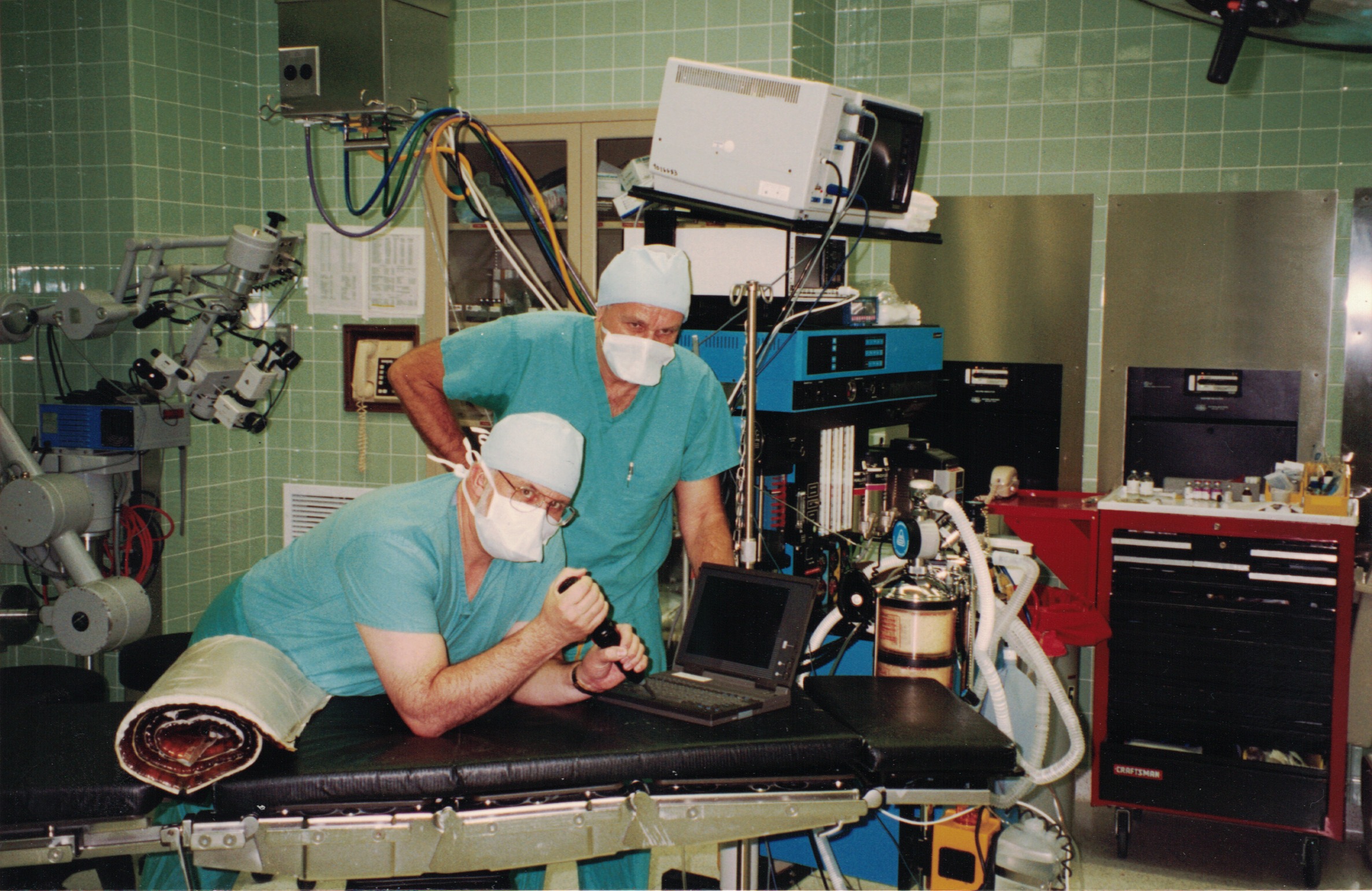
Kimmel & Gerke performing surgery on a lap-top computer.
We shared the data, but it did not stop there. We offered it to a leading magazine in the medical device community. We had been writing a technical column for them as part of our long term marketing strategy.
The loved it, and with our help, turned it into a technical report they offered for sale. The money earned from the report was minuscule, but the publicity was priceless! It further established our firm as a world-class leader in our niche. Not too bad for a couple of goof ball engineers out in Minnesota.
The report was well received, as it provided needed timely information. Meanwhile, the researchers were still twiddling their thumbs, while we gained visibility & credibility critical to our success as consultants.
We just did it! And you can too, but YOU need to take the initiative. Not only in consulting, but in life itself.
Cheers — Uncle Daryl
Ideas are good, but “ideas + action” are what get results.
© 2020, https:. All rights reserved.
Afraid to make the Jump? Overcoming the fear…
Do you want to make your JumpToConsulting, but the voices in your head hold you back? Yes, I often felt the way 32 year ago. But I jumped anyway, and am I glad I did!
So lets talk about overcoming those fears. The catalyst for this post was the book Mastering Fear. Written by former Navy SEAL Brandon Webb, the author shared his journey through fear to success. I could well identify with his fears on my journey to consulting.
Webb identified five steps in overcoming fears. I’ll elaborate on my experiences and offer suggestions based on the lessons I learned. Perhaps they will help you.
The five steps are decision, rehersal, letting go, jumping off (I particularly liked that stage), and finally, knowing what matters.
Decision – Mine was based on a layoff and later a firing. Disturbed by the lack of corporate integrity – I did not want to become a corporate pimp (as in having to fire good people) nor be a the mercy of corporate ineptitude.
Rehersal – Started by moonlighting, and later working from home. Wanted to see if I could handle not being part of a big organization. No problem — loved the freedom.
Letting Go – Decided to let go of the current career direction, and started making concrete plans for the future (including loading up the savings.)
Jumping Off – The first day in business (October 1987) the stock market crashed — but I jumped anyway. Scary? Yes, but I never looked back.
Knowing What Matters – To me, it was making a difference. Do some good, have some fun, make some money. Met all three objectives!
In closing, remember those famous words of Franklin Roosevelt, spoken in the depths of the depression at his first inaugural address in 1933 — “The only thing we have to fear is fear itself.” True then, true today!
The FREE Monthly Teleconference is Back!
Join us with your questions – or just listen in learn
“Ask Daryl Anything About Consulting”
© 2020, https:. All rights reserved.
Build a bridge – not a wall…
Heard this story years ago, and decided to share it here. It goes like this:
Two neighbors lived across a creek from each other. There was a small bridge connecting their two properties, and they became friends and enjoyed each other’s company.
But then there was a falling out, and neither spoke to each other. That winter, the bridge collapsed.
In the spring, the one neighbor decided to build a wall so he would not have to look across the creek to his neighbor. He had a load of lumber delivered, and planned to begin the wall that weekend.
Seeing the lumber, the other neighbor knocked on the door. He said, “I’m so happy to see you are rebuilding the bridge. I’ve really missed our friendship. Can I pay for half?”
Realizing the mistake he almost made, the first neighbor quickly agreed. And they build the bridge together.
So what does this have to do with consulting (or life in general?) Misunderstandings happen, and don’t be afraid to make the first move to fix them.
Build bridges — not walls!
Peace — Uncle Daryl
© 2019, https:. All rights reserved.